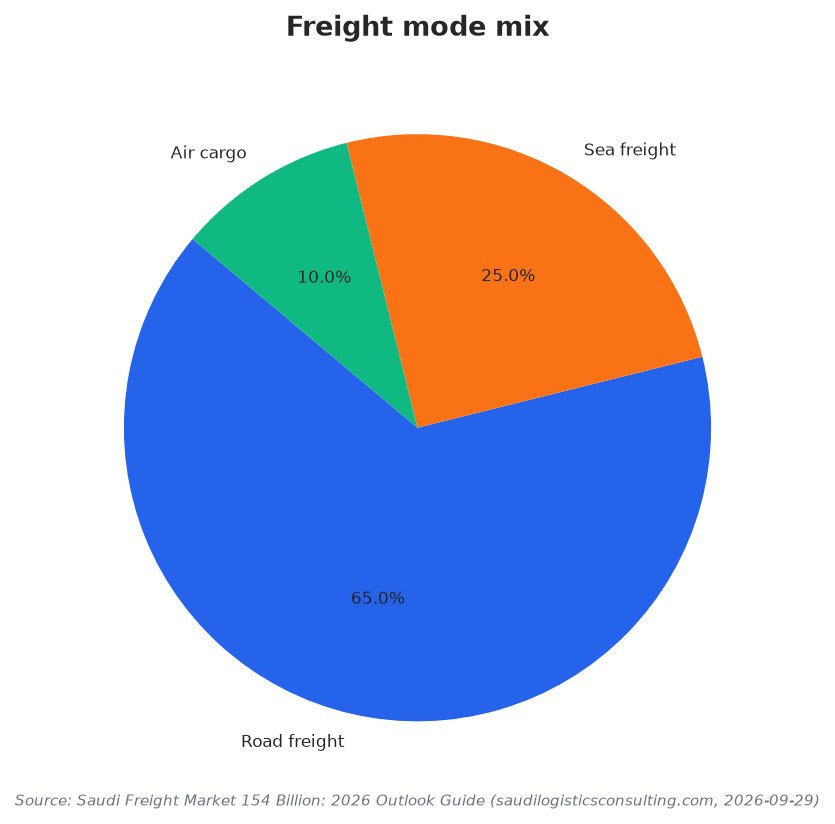
When sea lanes tighten, forwarders look for a Plan B that still preserves service levels. In Saudi Arabia, the question is not whether air can replace containers, but whether it can absorb a meaningful share of urgent spillover while ports, trucking, and rail rebalance. The freight mode mix shows why the issue is structural. Road freight accounts for 65% of total freight volume in the Kingdom, at 1.2 billion tons annually (2022). Sea freight contributes 25%, at 500 million tons annually. Air cargo is far smaller by tonnage, but it is growing and tends to carry higher-priority goods.
On the air side, reported throughput indicators are moving quickly. One source cites air cargo volume reaching 1.5 million tons in 2022, with an 8% CAGR since 2020. Another puts total air cargo at approximately 1.2 million tonnes in 2024, describing it as a 30% increase on the prior year. For longer-range planning, air freight is forecast to grow at 6.78% CAGR from 2026 to 2031, while a separate market outlook values the air cargo market at 1.0 million tons in 2025 and expects 2.6 million tons by 2034 at a 10.94% CAGR. Together, these figures frame a system scaling up, even if estimates differ by source and year.
What Would Make Airports a Real Overflow Valve?
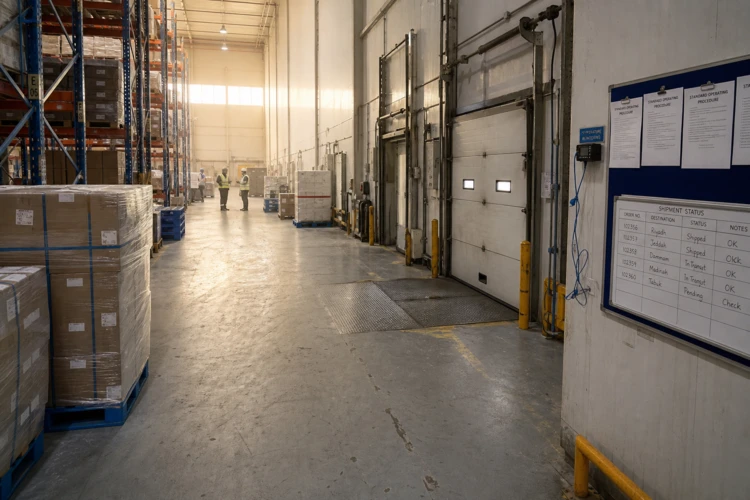
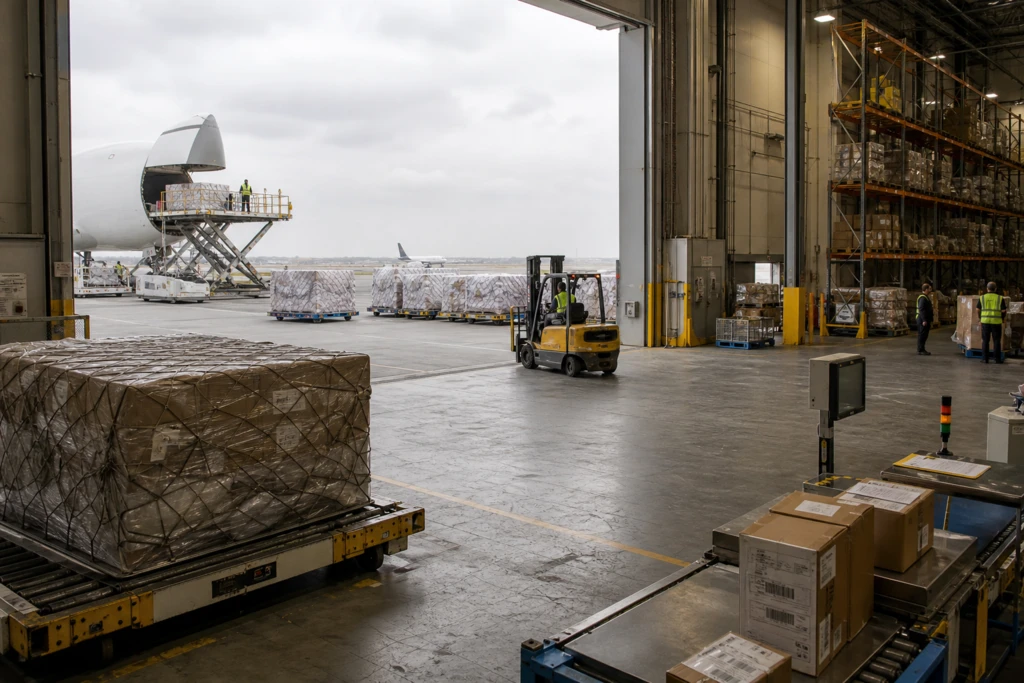
Overflow absorption depends on ground handling, warehousing, and network control as much as runways. SAL Saudi Logistics Services, which was spun off from Saudi Airlines Cargo in 2019, handles around 92% of national cargo volumes across 18 domestic airports, according to one analysis. That concentration can accelerate execution when volumes spike, but it also puts pressure on nodes like Riyadh. In May 2024, SAL committed USD 93 million to 90,000 m² of new air-cargo capacity at King Khalid International Airport, bundling line-haul handling, sortation, and short-stay storage. In value terms, warehousing and storage in the Saudi freight and logistics market surpassed USD 8.23 billion in 2025, and cold-chain space is expanding faster than dry storage as pharmaceutical imports climb.
Capacity is also being shaped by integrated zones and fleet plans designed to pull demand toward airports. King Salman International Airport’s Special Integrated Logistics Zone spans 3 million m², with Apple and Shein signed as tenants, and a Sino-Logistics Zone at the same airport is under construction. On aircraft availability, Riyadh Air has stated an ambition of serving more than 100 international destinations by 2030, and Boeing confirmed firmed commitments for 67 787 Dreamliners, including 20 of the 787-10 variant, alongside 31 firm Airbus A350-1000s. Separately, Saudia Cargo has a plan to reach 27 aircraft by 2030. These measures support more belly and freighter options when sea schedules become unreliable.
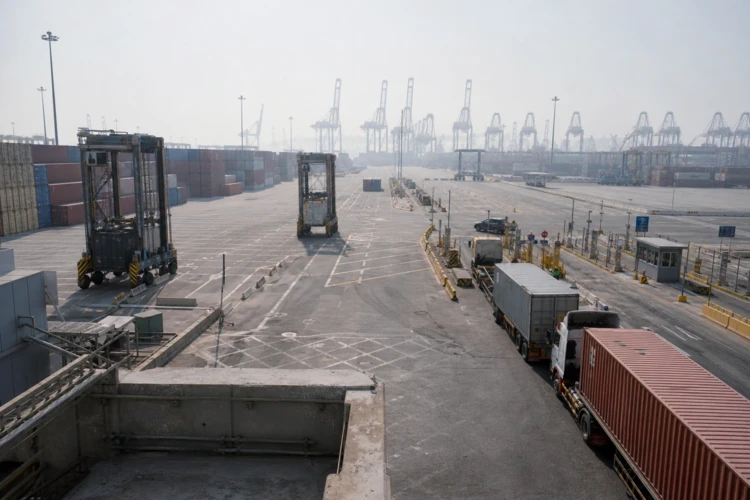
Still, the strongest answer to sea-freight overflow is multimodal resilience, not a single substitute. During the 2024–2025 Red Sea disruption, throughput contractions were reported at Jeddah Islamic Port and King Abdullah Port, while Saudi Arabia accelerated eastern port upgrades, Landbridge development, and air cargo capacity expansion. The domestic Saudi Landbridge is described as connecting Jeddah Islamic Port to Dammam across approximately 1,300 kilometres, backed by an estimated USD 7 billion investment. A separate example of multimodal routing came after disruption to Strait of Hormuz transits earlier in 2026, when MSC launched a Europe to Gulf service on 10 May 2026 calling at Jeddah and King Abdullah Port, then trucking containers roughly 1,300 kilometres to King Abdulaziz Port in Dammam for onward feeder distribution.
Can Saudi airports realistically absorb sea-freight overflow?
What recent throughput signals suggest Saudi Arabia’s air cargo is scaling?
Which investments directly expand air-side handling and storage capacity?
How concentrated is air cargo handling across Saudi airports?
What do forecasts imply for the Saudi Arabia air cargo market over time?