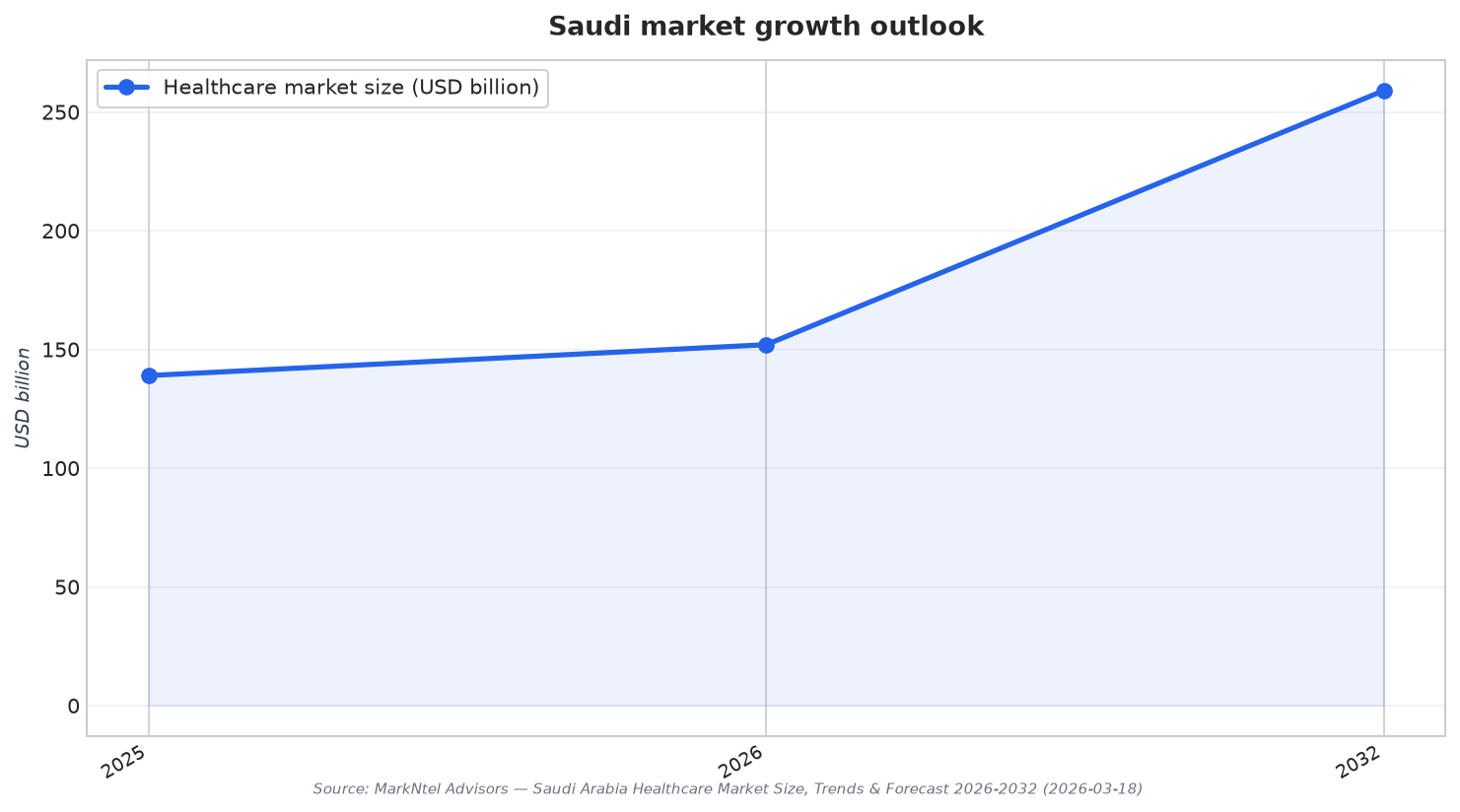
In 2026, Saudi healthcare conversations are increasingly shaped by deal discipline, partnership design, and proof of operational impact. The backdrop is a growing local system. A market outlook projects the Saudi Arabian healthcare market at USD 152 billion in 2026, up from USD 139 billion in 2025, with a 2026–2032 CAGR of 9.35% and a 2032 forecast of USD 259 billion. Capacity markers also frame what partners can build on: 516 hospitals, an average of 23.4 beds per 10,000 people, and nationwide staffing of 129,772 physicians and 243,336 nurses. These baseline figures set the stakes for how providers, investors, and suppliers structure new collaborations.
Deal flow signals are also global, and Saudi participants often benchmark against them. In medtech, total M&A value reached about USD 80 billion through Nov. 30, 2025, with activity concentrated in the second half as deal value nearly doubled the first half while valuations continued to decline, based on a Bain report cited by MedTech Dive. Large 2025 announcements included Abbott’s planned USD 21 billion acquisition of Exact Sciences and Hologic’s USD 18.3 billion go-private deal. Moving into 2026, Boston Scientific announced plans to acquire Penumbra for USD 14.5 billion, and Smith & Nephew proposed buying Integrity Orthopaedics for up to USD 450 million. Bain also cited USD 27 billion in spinoffs or divestitures in 2025, about a third of total deal value, reinforcing why carve-outs and asset recycling can become partnership opportunities, including cross-border ones.
Partnership Models Are Shifting: Structure, Risk, and Measurable Outcomes
What stands out for 2026 is not just volume, but how transactions and partnerships are built. PwC’s James Woods told MobiHealthNews that acquirers are increasingly using staged transactions, minority investments, carve-outs, and structured capital solutions to manage risk while keeping strategic upside. He also highlighted earlier integration planning, with a focus on operational resilience, diversified sourcing, and regulatory compliance from day one, and that success will come from pairing strategic conviction with rigorous, scenario-based execution planning. This aligns with another cited point: scalable digital infrastructure and measurable clinical or operational impact are treated as premium attributes. At Global Health Exhibition Riyadh 2026, the partners who win mindshare are likely to be those who show hard execution plans, not just big visions.
Saudi policy and payor dynamics add pressure that changes partner selection. A sector note describes a structural headwind for provider pricing, pointing to DRG rollout, insurance repricing cycles, and a shift to value-based contracting that collectively indicate a declining margin trend over the longer term. It argues that scale and operational efficiency will determine which operators can offset price pressure through volume and market share gains. The same note describes privatization as a central pillar of Vision 2030’s Health Sector Transformation Program, with the Ministry of Health implementing plans since 2018 to transition public assets into models enabling private participation through public-private partnerships. It also notes insured lives rebounded strongly after an earlier expatriate workforce adjustment, when about 1.05 million expats exited between early 2018 and 3Q21 due to the expat levy and COVID-related job losses.
The investment conversation also runs through FDI, payors, and disease demand. Saudi Arabia targets annual foreign direct investment inflows of USD 100 billion by 2030, up from approximately USD 8 billion in 2016, and a KPI snapshot lists inbound FDI at USD 21.3B. On the payor layer, Mordor Intelligence values the Saudi Arabia health and medical insurance market (premium value) at USD 10.53 billion in 2025 and estimates growth from USD 11.41 billion in 2026 to USD 16.12 billion by 2031 at a 7.16% CAGR. Demand priorities are clear in local epidemiology projections: about 37% of total patients in 2026 are affected by cardiovascular diseases, while diabetes affects around 23.1% of the population in 2026. Together, these signals point to partnerships that combine clinical focus, reimbursement readiness, and efficiency-first operating models.
What does Global Health Exhibition Riyadh 2026 signal about deal flow in Saudi healthcare?
Why are structured transactions becoming more common in 2026?
What policy forces are pressuring provider margins in Saudi Arabia?
Which Saudi healthcare indicators matter most for partnership planning in 2026?