The IMF’s October 2026 World Economic Outlook projects Saudi Arabia’s real GDP will contract by 3.3% in 2026 and then expand by 7.9% in 2027. That combination can look like a simple setback-and-recovery story, but corporate planning should read it as a change in the near-term operating environment. The same IMF update marks a five-percentage-point downgrade versus its July call for 2026, when it had forecast 1.7% growth. At the same time, the Fund lifted its 2027 view by 2.4 percentage points from July. For executives, this is a shift from planning for continued expansion to planning for a contraction first, with a recovery that follows only under specific conditions.
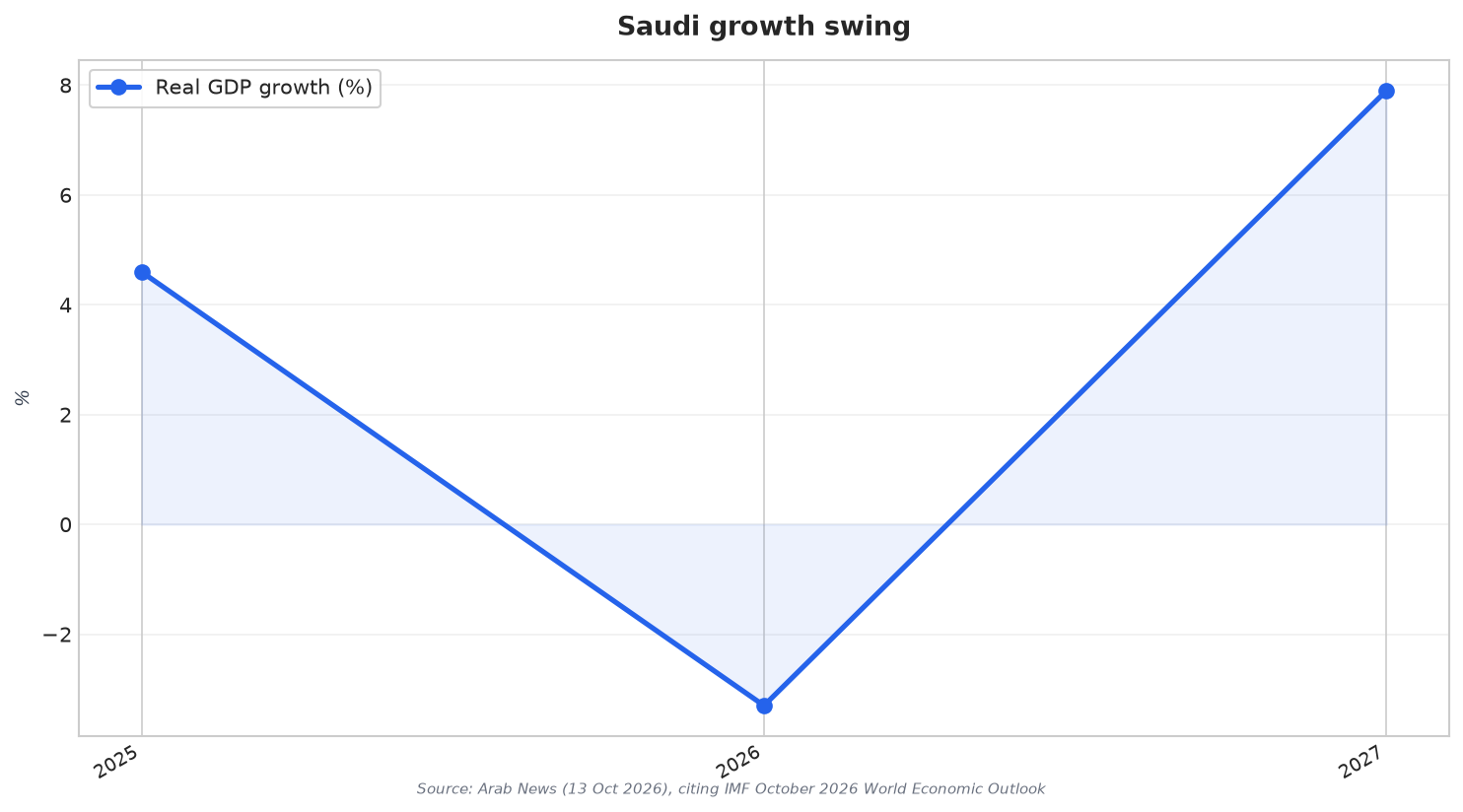
The October path also matters because a bigger rebound does not automatically restore the earlier trajectory. One source normalizes 2025 real GDP to an illustrative index of 100 and shows that, when the forecast years are compounded, the new October path leaves 2027 output about 2.75% below what the July path implied (computed as 104.34 divided by 107.29 minus one). In other words, even though the 7.9% rebound more than restores the 2025 level, it still implies a lower 2027 level than the pre-revision path. This distinction is commercially important for capacity planning, asset utilization, and the timing of discretionary spending.
What to Build Into Budgets: Assumptions, Timing, and Liquidity
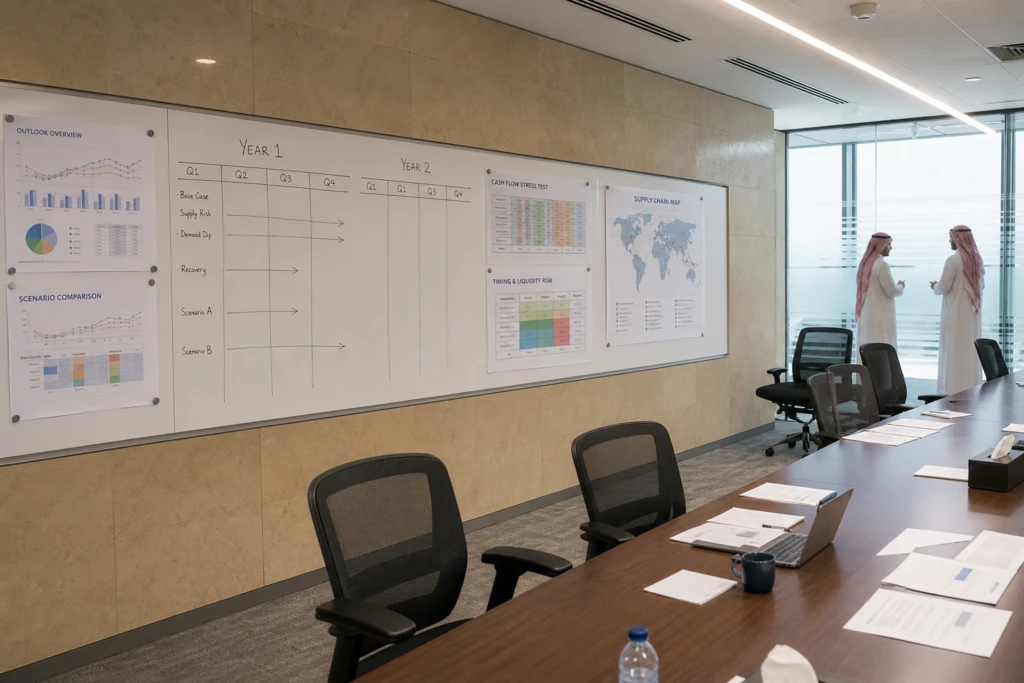
Boards should also interrogate the assumptions behind the rebound. The IMF scenario described in one analysis assumes reopening of the Strait of Hormuz resumes in March 2027, with conditions broadly returning to their pre-war state by October 2027. It is described as a modelling assumption affecting production, shipping, insurance, and payments, not a confirmed timetable. That framing points to practical steps for corporate planning: budget to the base case, but stress-test delays in shipping normalization, slower restoration of trade conditions, and uneven recovery in customer payment cycles. The IMF’s own framing of global conditions also highlights uncertainty: it projects world growth of 3.1% in 2026 and 3.4% in 2027, with global inflation at 4.7% in 2026.
For Saudi operations, the contraction-and-rebound profile can change working-capital needs more than it changes long-run intent. A July-style plan implied a growing 2026 market; the October update implies a year that may require tighter liquidity management before expansion returns. Saudi inflation is projected at 1.9% in 2026 and 2.2% in 2027 in the IMF’s October WEO coverage cited by Arab News, while another IMF-based report describes inflation estimated to average 2.7% in 2026 before settling near 2% in subsequent years. Firms can use this range as a planning reference while prioritizing contract structures that reduce cash-flow surprises, such as clearer payment milestones and contingency clauses linked to logistics disruptions.
Finally, CFOs and strategy teams can connect macro forecasts to capital discipline signals visible in published fiscal and corporate data points. One report cites a pre-budget statement that raised the 2026 deficit estimate to 245 billion riyals and forecast oil activities contracting 21.8%. The same source reports that the December budget had projected debt reaching 1.62 trillion riyals at 32.7% of GDP, while by mid-2026 actual debt stood at approximately 1.685 trillion riyals. It also cites a 2027 outlook embedded in the pre-budget statement: spending of 1.39 trillion riyals against revenue of 1.20 trillion, for a deficit of 191 billion riyals at 3.6% of GDP. Treated alongside the Saudi Arabia IMF forecast 2026 contraction and the 2027 rebound, these figures reinforce why scenario planning should prioritize funding access, phased capex, and operational flexibility.
What does the IMF project for Saudi Arabia’s growth in 2026 and 2027?
How did the IMF’s October update change from its July view?
Does a 7.9% rebound in 2027 fully restore the earlier output path?
What key assumption sits behind the rebound scenario?
How should corporate planners use the Saudi Arabia IMF forecast for 2026 in budgeting?