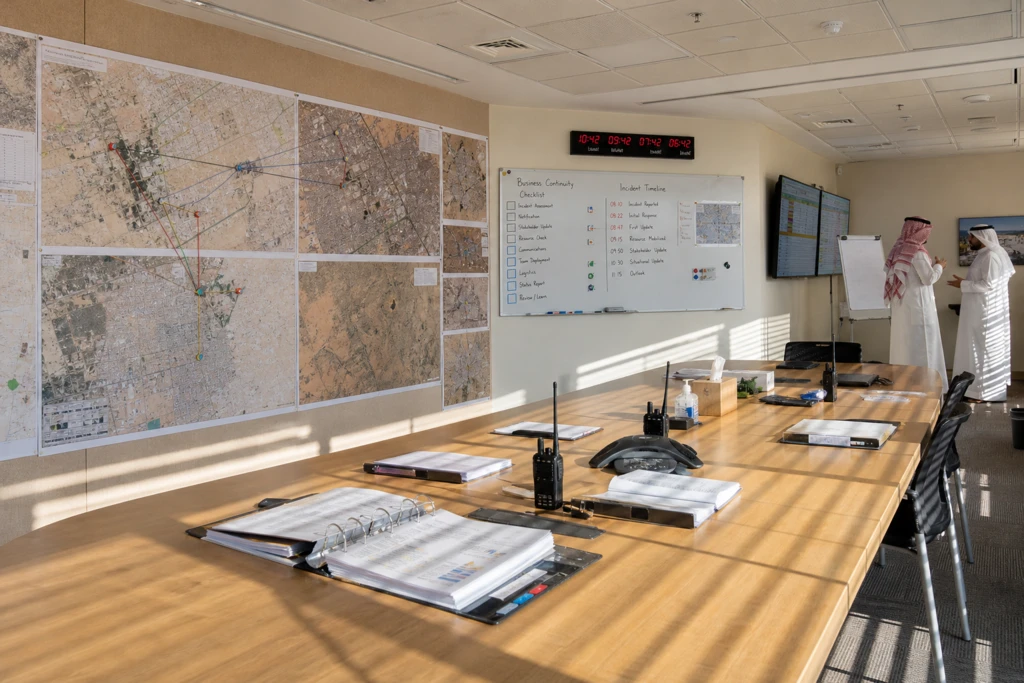
Saudi Arabia’s operating environment is being reshaped by recurring Houthi strikes that increasingly touch civilian and commercial nodes. Bloomberg reported weeks of sporadic strikes that have claimed dozens of lives, curbed air travel in Riyadh, delayed showpiece events, and effectively shut the capital’s financial district. For companies, this shifts business continuity from a hypothetical crisis plan to a practical daily requirement, spanning staff safety, travel, site access, and service delivery. The risk is not limited to the direct blast radius. Repeated headlines can change how counterparties behave, from customer attendance to supplier scheduling and executive mobility.
Operational disruption has a clear aviation footprint. ACLED reported damage or fires at airports in Riyadh, Abha, Jizan, Najran, and Dammam, while satellite imagery suggests damage occurred at Sharurah as well. Riyadh’s King Khalid International Airport has been hit on four separate days since 7 October, with at least 18 people killed and more than 300 wounded, according to ACLED. This creates immediate continuity questions for firms that depend on predictable air links for leadership travel, specialist contractors, high-value cargo, or time-sensitive services. The same ACLED analysis warns that continued attacks threaten aviation and energy infrastructure, with economic consequences extending beyond physical damage.
From Asset Damage to Market Shock: How Risk Propagates Through Operations
Even when production continues, corporate premises and market sentiment can absorb the shock. PESTLE & MORTAR reported confirmed physical damage on 8 November to Aramco’s Riyadh administrative tower, describing it as a bounded security incident with material implications for business continuity in the capital. The same brief notes Saudi authorities reported no casualties or production shutdown, but emphasized exposure across staff, premises, movement, and corporate operations. Financial markets have also shown sensitivity. Africa Insights cited earlier market data after an attack on Riyadh showing the Tadawul All Share Index (TASI) falling 0.5%, with Saudi Aramco down 0.6% and Saudi National Bank off 0.5%, illustrating how quickly security incidents can translate into risk-off moves.
That pricing effect can tighten operating conditions even for companies not directly hit. Bloomberg wrote that Saudi stocks have slumped so much that they are among the month’s worst performers in global emerging markets, reinforcing how non-oil confidence can become the focal point. The Financial Express also reported that Riyadh-listed equities slid to a three-and-a-half-year low after weekend attacks, and that Saudi Arabian long-dated bonds tumbled. In parallel, it reported extensive fire damage to the headquarters of oil giant Saudi Aramco, and said the Houthis vowed to ramp up strikes against airports and oil facilities. For corporate risk teams, this is the “Houthi attacks Saudi Arabia business impact” story in practice: broader financing, insurance, and counterpart risk can move even when core production assets remain running.
Practical continuity planning now needs to assume recurring, geographically distributed disruption. ACLED described intensifying attacks that expose critical infrastructure to recurring disruption, while highlighting the possibility of threats from multiple directions if broader regional escalation triggers additional attacks. THINK TANK JOURNAL framed the secondary cost channels that matter to businesses: an airline may change its operational plans, an insurer may increase premiums, a shipping company may choose a longer route, and an investor may demand a higher return to compensate for geopolitical risk. PESTLE & MORTAR added a crucial operational lesson: even when interceptions are occurring, Gulf missile interceptions can still damage commercial premises away from energy production sites. For companies in Riyadh and beyond, continuity under fire increasingly means redundant travel options, remote-work readiness, and clear site-level response playbooks.
How are Houthi strikes changing business continuity planning in Saudi Arabia?
What has been reported about impacts on Riyadh’s airport operations?
What market signals show the Houthi attacks’ business impact in Saudi Arabia?
What did reports say about damage to corporate facilities in Riyadh?
How should companies interpret the broader risk from repeated attacks?